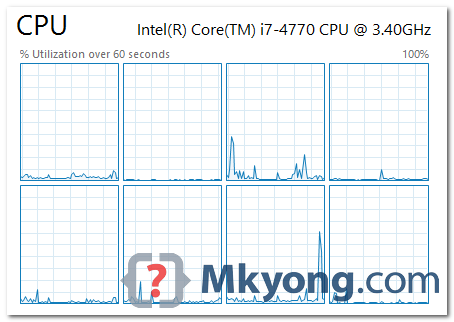
A code snippet to show you how to get the number of available processors / cores / CPUs in your environment.
	int processors = Runtime.getRuntime().availableProcessors();
	System.out.println(processors);
Output
8
P.S Tested with Intel(R) Core(TM) i7-4770 CPU @3.40GHz

Thanx man
/*
* $Id: PdfNumber.java 4784 2011-03-15 08:33:00Z blowagie $
*
* This file is part of the iText (R) project.
* Copyright (c) 1998-2011 1T3XT BVBA
* Authors: Bruno Lowagie, Paulo Soares, et al.
*
* This program is free software; you can redistribute it and/or modify
* it under the terms of the GNU Affero General Public License version 3
* as published by the Free Software Foundation with the addition of the
* following permission added to Section 15 as permitted in Section 7(a):
* FOR ANY PART OF THE COVERED WORK IN WHICH THE COPYRIGHT IS OWNED BY 1T3XT,
* 1T3XT DISCLAIMS THE WARRANTY OF NON INFRINGEMENT OF THIRD PARTY RIGHTS.
*
* This program is distributed in the hope that it will be useful, but
* WITHOUT ANY WARRANTY; without even the implied warranty of MERCHANTABILITY
* or FITNESS FOR A PARTICULAR PURPOSE.
* See the GNU Affero General Public License for more details.
* You should have received a copy of the GNU Affero General Public License
* along with this program; if not, see http://www.gnu.org/licenses or write to
* the Free Software Foundation, Inc., 51 Franklin Street, Fifth Floor,
* Boston, MA, 02110-1301 USA, or download the license from the following URL:
* http://itextpdf.com/terms-of-use/
*
* The interactive user interfaces in modified source and object code versions
* of this program must display Appropriate Legal Notices, as required under
* Section 5 of the GNU Affero General Public License.
*
* In accordance with Section 7(b) of the GNU Affero General Public License,
* a covered work must retain the producer line in every PDF that is created
* or manipulated using iText.
*
* You can be released from the requirements of the license by purchasing
* a commercial license. Buying such a license is mandatory as soon as you
* develop commercial activities involving the iText software without
* disclosing the source code of your own applications.
* These activities include: offering paid services to customers as an ASP,
* serving PDFs on the fly in a web application, shipping iText with a closed
* source product.
*
* For more information, please contact iText Software Corp. at this
* address: [email protected]
*/
package com.itextpdf.text.pdf;
import com.itextpdf.text.error_messages.MessageLocalization;
/**
*
PdfNumberprovides two types of numbers, integer and real.*
* Integers may be specified by signed or unsigned constants. Reals may only be
* in decimal format.
* This object is described in the ‘Portable Document Format Reference Manual
* version 1.7’ section 3.3.2 (page 52-53).
*
* @see PdfObject
* @see BadPdfFormatException
*/
public class PdfNumber extends PdfObject {
// CLASS VARIABLES
/**
* actual value of this
PdfNumber, represented as a*
double*/
private double value;
// CONSTRUCTORS
/**
* Constructs a
PdfNumber-object.*
* @param content value of the new
PdfNumber-object*/
public PdfNumber(String content) {
super(NUMBER);
try {
value = Double.parseDouble(content.trim());
setContent(content);
}
catch (NumberFormatException nfe){
throw new RuntimeException(MessageLocalization.getComposedMessage(“1.is.not.a.valid.number.2”, content, nfe.toString()));
}
}
/**
* Constructs a new
PdfNumber-object of type integer.*
* @param value value of the new
PdfNumber-object*/
public PdfNumber(int value) {
super(NUMBER);
this.value = value;
setContent(String.valueOf(value));
}
/**
* Constructs a new
PdfNumber-object of type real.*
* @param value value of the new
PdfNumber-object*/
public PdfNumber(double value) {
super(NUMBER);
this.value = value;
setContent(ByteBuffer.formatDouble(value));
}
/**
* Constructs a new
PdfNumber-object of type real.*
* @param value value of the new
PdfNumber-object*/
public PdfNumber(float value) {
this((double)value);
}
// methods returning the value of this object
/**
* Returns the primitive
intvalue of this object.*
* @return The value as
int*/
public int intValue() {
return (int) value;
}
/**
* Returns the primitive
doublevalue of this object.*
* @return The value as
double*/
public double doubleValue() {
return value;
}
/**
* Returns the primitive
floatvalue of this object.*
* @return The value as
float*/
public float floatValue() {
return (float)value;
}
// other methods
/**
* Increments the value of the
PdfNumber-object by 1.*/
public void increment() {
value += 1.0;
setContent(ByteBuffer.formatDouble(value));
}
}