In this tutorial, we show you how to integrate AspectJ annotation with Spring AOP framework. In simple, Spring AOP + AspectJ allow you to intercept method easily.
Common AspectJ annotations :
- @Before – Run before the method execution
- @After – Run after the method returned a result
- @AfterReturning – Run after the method returned a result, intercept the returned result as well.
- @AfterThrowing – Run after the method throws an exception
- @Around – Run around the method execution, combine all three advices above.
For Spring AOP without AspectJ support, read this build-in Spring AOP examples.
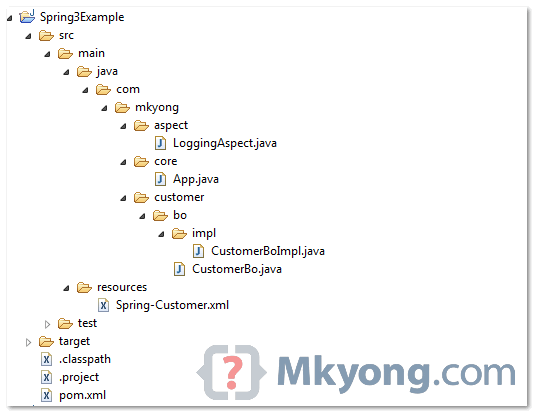
1. Directory Structure
See directory structure of this example.
2. Project Dependencies
To enable AspectJ, you need aspectjrt.jar, aspectjweaver.jar and spring-aop.jar. See following Maven pom.xml file.
This example is using Spring 3, but the AspectJ features are supported since Spring 2.0.
File : pom.xml
<project ...>

	<properties>
		<spring.version>3.0.5.RELEASE</spring.version>
	</properties>

	<dependencies>

		<dependency>
			<groupId>org.springframework</groupId>
			<artifactId>spring-core</artifactId>
			<version>${spring.version}</version>
		</dependency>

		<dependency>
			<groupId>org.springframework</groupId>
			<artifactId>spring-context</artifactId>
			<version>${spring.version}</version>
		</dependency>

		<!-- Spring AOP + AspectJ -->
		<dependency>
			<groupId>org.springframework</groupId>
			<artifactId>spring-aop</artifactId>
			<version>${spring.version}</version>
		</dependency>

		<dependency>
			<groupId>org.aspectj</groupId>
			<artifactId>aspectjrt</artifactId>
			<version>1.6.11</version>
		</dependency>

		<dependency>
			<groupId>org.aspectj</groupId>
			<artifactId>aspectjweaver</artifactId>
			<version>1.6.11</version>
		</dependency>

	</dependencies>
</project>
3. Spring Beans
Normal bean, with few methods, later intercept it via AspectJ annotation.
package com.mkyong.customer.bo;

public interface CustomerBo {

	void addCustomer();

	String addCustomerReturnValue();

	void addCustomerThrowException() throws Exception;

	void addCustomerAround(String name);
}
package com.mkyong.customer.bo.impl;

import com.mkyong.customer.bo.CustomerBo;

public class CustomerBoImpl implements CustomerBo {

	public void addCustomer(){
		System.out.println("addCustomer() is running ");
	}

	public String addCustomerReturnValue(){
		System.out.println("addCustomerReturnValue() is running ");
		return "abc";
	}

	public void addCustomerThrowException() throws Exception {
		System.out.println("addCustomerThrowException() is running ");
		throw new Exception("Generic Error");
	}

	public void addCustomerAround(String name){
		System.out.println("addCustomerAround() is running, args : " + name);
	}
}
4. Enable AspectJ
In Spring configuration file, put “<aop:aspectj-autoproxy />“, and define your Aspect (interceptor) and normal bean.
File : Spring-Customer.xml
<beans xmlns="http://www.springframework.org/schema/beans"
	xmlns:xsi="http://www.w3.org/2001/XMLSchema-instance"
	xmlns:aop="http://www.springframework.org/schema/aop"
	xsi:schemaLocation="http://www.springframework.org/schema/beans
	http://www.springframework.org/schema/beans/spring-beans-3.0.xsd
	http://www.springframework.org/schema/aop
	http://www.springframework.org/schema/aop/spring-aop-3.0.xsd ">

	<aop:aspectj-autoproxy />

	<bean id="customerBo" class="com.mkyong.customer.bo.impl.CustomerBoImpl" />

	<!-- Aspect -->
	<bean id="logAspect" class="com.mkyong.aspect.LoggingAspect" />

</beans>
4. AspectJ @Before
In below example, the logBefore() method will be executed before the execution of customerBo interface, addCustomer() method.
AspectJ “pointcuts” is used to declare which method is going to intercept, and you should refer to this Spring AOP pointcuts guide for full list of supported pointcuts expressions.
File : LoggingAspect.java
package com.mkyong.aspect;

import org.aspectj.lang.JoinPoint;
import org.aspectj.lang.annotation.Aspect;
import org.aspectj.lang.annotation.Before;

@Aspect
public class LoggingAspect {

	@Before("execution(* com.mkyong.customer.bo.CustomerBo.addCustomer(..))")
	public void logBefore(JoinPoint joinPoint) {

		System.out.println("logBefore() is running!");
		System.out.println("hijacked : " + joinPoint.getSignature().getName());
		System.out.println("******");
	}

}
Run it
	CustomerBo customer = (CustomerBo) appContext.getBean("customerBo");
	customer.addCustomer();
Output
logBefore() is running!
hijacked : addCustomer
******
addCustomer() is running
5. AspectJ @After
In below example, the logAfter() method will be executed after the execution of customerBo interface, addCustomer() method.
File : LoggingAspect.java
package com.mkyong.aspect;

import org.aspectj.lang.JoinPoint;
import org.aspectj.lang.annotation.Aspect;
import org.aspectj.lang.annotation.After;

@Aspect
public class LoggingAspect {

	@After("execution(* com.mkyong.customer.bo.CustomerBo.addCustomer(..))")
	public void logAfter(JoinPoint joinPoint) {

		System.out.println("logAfter() is running!");
		System.out.println("hijacked : " + joinPoint.getSignature().getName());
		System.out.println("******");

	}

}
Run it
	CustomerBo customer = (CustomerBo) appContext.getBean("customerBo");
	customer.addCustomer();
Output
addCustomer() is running
logAfter() is running!
hijacked : addCustomer
******
6. AspectJ @AfterReturning
In below example, the logAfterReturning() method will be executed after the execution of customerBo interface, addCustomerReturnValue() method. In addition, you can intercept the returned value with the “returning” attribute.
To intercept returned value, the value of the “returning” attribute (result) need to be same with the method parameter (result).
File : LoggingAspect.java
package com.mkyong.aspect;

import org.aspectj.lang.JoinPoint;
import org.aspectj.lang.annotation.Aspect;
import org.aspectj.lang.annotation.AfterReturning;

@Aspect
public class LoggingAspect {

   @AfterReturning(
      pointcut = "execution(* com.mkyong.customer.bo.CustomerBo.addCustomerReturnValue(..))",
      returning= "result")
   public void logAfterReturning(JoinPoint joinPoint, Object result) {

	System.out.println("logAfterReturning() is running!");
	System.out.println("hijacked : " + joinPoint.getSignature().getName());
	System.out.println("Method returned value is : " + result);
	System.out.println("******");

   }

}
Run it
	CustomerBo customer = (CustomerBo) appContext.getBean("customerBo");
	customer.addCustomerReturnValue();
Output
addCustomerReturnValue() is running
logAfterReturning() is running!
hijacked : addCustomerReturnValue
Method returned value is : abc
******
7. AspectJ @AfterReturning
In below example, the logAfterThrowing() method will be executed if the customerBo interface, addCustomerThrowException() method is throwing an exception.
File : LoggingAspect.java
package com.mkyong.aspect;

import org.aspectj.lang.JoinPoint;
import org.aspectj.lang.annotation.Aspect;
import org.aspectj.lang.annotation.AfterThrowing;

@Aspect
public class LoggingAspect {

   @AfterThrowing(
      pointcut = "execution(* com.mkyong.customer.bo.CustomerBo.addCustomerThrowException(..))",
      throwing= "error")
    public void logAfterThrowing(JoinPoint joinPoint, Throwable error) {

	System.out.println("logAfterThrowing() is running!");
	System.out.println("hijacked : " + joinPoint.getSignature().getName());
	System.out.println("Exception : " + error);
	System.out.println("******");

    }
}
Run it
	CustomerBo customer = (CustomerBo) appContext.getBean("customerBo");
	customer.addCustomerThrowException();
Output
addCustomerThrowException() is running
logAfterThrowing() is running!
hijacked : addCustomerThrowException
Exception : java.lang.Exception: Generic Error
******
Exception in thread "main" java.lang.Exception: Generic Error
	//...
8. AspectJ @Around
In below example, the logAround() method will be executed before the customerBo interface, addCustomerAround() method, and you have to define the “joinPoint.proceed();” to control when should the interceptor return the control to the original addCustomerAround() method.
File : LoggingAspect.java
package com.mkyong.aspect;

import org.aspectj.lang.ProceedingJoinPoint;
import org.aspectj.lang.annotation.Aspect;
import org.aspectj.lang.annotation.Around;

@Aspect
public class LoggingAspect {

   @Around("execution(* com.mkyong.customer.bo.CustomerBo.addCustomerAround(..))")
   public void logAround(ProceedingJoinPoint joinPoint) throws Throwable {

	System.out.println("logAround() is running!");
	System.out.println("hijacked method : " + joinPoint.getSignature().getName());
	System.out.println("hijacked arguments : " + Arrays.toString(joinPoint.getArgs()));

	System.out.println("Around before is running!");
	joinPoint.proceed(); //continue on the intercepted method
	System.out.println("Around after is running!");

	System.out.println("******");

   }

}
Run it
	CustomerBo customer = (CustomerBo) appContext.getBean("customerBo");
	customer.addCustomerAround("mkyong");
Output
logAround() is running!
hijacked method : addCustomerAround
hijacked arguments : [mkyong]
Around before is running!
addCustomerAround() is running, args : mkyong
Around after is running!
******
Conclusion
It’s always recommended to apply the least power AsjectJ annotation. It’s rather long article about AspectJ in Spring. for further explanations and examples, please visit the reference links below.
No worry, AspectJ supported XML configuration also, read this Spring AOP + AspectJ XML example.

Thanks! Very helpful!
Is it possible to apply the AOP concept in website(with spring mvc) means before any bean method, can we execute any aspect
i called @before on controller but want to stop execution of controller if user is not logged-in and want to return something as response-body (json shows the status that USER NOT LOGGED-IN ) else normal controller execution??(work around i throw error(“USER NOT LOGGED-IN”)) but want permanent solution.
I had a question. Is it possible to get method argument names in @Around advice?
Using java 7
There is typo AfterThrowing —> AfterReturning
I need to log method calling methods ?? Any tutorial on LTW .
What is the best method to log chained method! ?? I don’t know MAVEN so please any solution through spring
7. AspectJ @AfterReturning has to be 7. AspectJ @AfterThrowing
Hi,
My main package folder is com.base and it has multiple folders like aspect, dao, web/controller, domain, service etc
I want to apply this aspect for all the methods from all the classes under com.base folder.
My spring config (web-servlet.xml) has
I have created one logging aspect as below
@Aspect
public class LoggingAspect {
/** Following is the definition for a pointcut to select
* all the methods available. So advice will be called
* for all the methods.
*/
@Pointcut(“execution(* com.base.*.*(..))”)
private void selectAll(){System.out.println(“logBefore() is running!”);}
/**
* This is the method which I would like to execute
* before a selected method execution.
*/
@Before(“selectAll()”)
public void logBefore(JoinPoint joinPoint) {
MDC.put(“logFileName”, “AppLog”);
System.out.println(“logBefore() is running!”);
System.out.println(“hijacked : ” + joinPoint.getSignature().getName());
System.out.println(“******”);
MDC.remove(“logFileName”);
}
}
But when I run my application, I am not getting any message printed on console from this logger aspect.
Please help. Thanks in Advance.
Amrut
The pattern for execution is as below:
@Pointcut(“execution(* com.base.*.*.*(..))”)
–Notice the extra * added in the pattern. Depending upon level of packages, you may need to give that..
The 7th point.. Please make it @AfterThrowing..6th and 7th both has @AfterReturning, a typo mistake..
do you have any idea how i can get the trace of the current running method? like i need to get the full text of the current method in a running program, not the name, signature etc.
I am getting an exception as:
java.lang.IllegalArgumentException: Can not set com.fasterxml.jackson.databind.ObjectMapper field in.dao.whooshbox.BaseDao.mapper to com.sun.proxy.$Proxy30
at sun.reflect.UnsafeFieldAccessorImpl.throwSetIllegalArgumentException(UnsafeFieldAccessorImpl.java:167)
at sun.reflect.UnsafeFieldAccessorImpl.throwSetIllegalArgumentException(UnsafeFieldAccessorImpl.java:171)
at sun.reflect.UnsafeObjectFieldAccessorImpl.set(UnsafeObjectFieldAccessorImpl.java:81)
at java.lang.reflect.Field.set(Field.java:764)
at org.springframework.beans.factory.annotation.AutowiredAnnotationBeanPostProcessor$AutowiredFieldElement.inject(AutowiredAnnotationBeanPostProcessor.java:551)
at org.springframework.beans.factory.annotation.InjectionMetadata.inject(InjectionMetadata.java:87)
at org.springframework.beans.factory.annotation.AutowiredAnnotationBeanPostProcessor.postProcessPropertyValues(AutowiredAnnotationBeanPostProcessor.java:331)
Could you please help me figure out the issue.
Hi? The 7 should be @AfterThrowing
I have a question on enabling logging for different methods in classes of a module: Do I need to create bean object from context for each class intending to get logging. Is there any way I can enable logging for every method using aspectj without creating object through context. Also, incase of a method inside the same class. I would not need to create a object. I can simply call the method by name. How to enable logging for it?
I have one service method which calls the Dao method to fetch the record from the database. When i deploy the web application it is working fine and fetching the records from database but the moment i apply the around advice(which just have the sysout statements) on the service method, it is returning the null value. When i enabled the debug logger level i have noticed the below behavior
1. As per the logs, the dao method successfully loads the records from database
2. The aspect is also applied on the service method
But I’m not sure, on applying aspect, why I’m getting the null value in controller from service? Can any one help me on this
This is resolved now. Some how the @Aspect and @Component annotation was applied on the loggingAspect class, as soon as i removed @component annotation, it worked!
great tutorial.. 🙂
thank, Mkyoung!!
i need one help from you, that is can we have one post about @Configurable please,, please explain me at [email protected]
An important note for @Around is missing here and that is that an @Around advice must also return the value from the call to joinPoint.proceed() – you should correct the sample or at least add a note about it
Please fix the section title on the page https://mkyong.com/spring3/spring-aop-aspectj-annotation-example/. The correct section title “7. AspectJ @AfterThrowing”
Great tutorial! 😀
Thanks for putting all this together.
I have a one question in spring transaction management AOP is used and following XML configuration is used to manage transaction.
I don’t see any pointcut (Before/after/AfterReturning/AfterThrowing/Around) like . Please help me out to understand that how this transaction advise executes.
Thanks
I do believe all of the ideas you’ve introduced for your post. They’re very convincing and can certainly work.
Still, the posts are too brief for beginners. May you please extend them a bit from next time?
Thanks for the post.
good,thanks
Hi i am a completely newbie in AOP what if i need to to fill some fields in a class before call another method some flags (update,delete,save) i use beforeAdvice
@Before(“execution(* com.mkyong.customer.bo.CustomerBo.addCustomer(..))”)
public void logBefore(JoinPoint joinPoint)
{
System.out.println(“logBefore() is running!”);
System.out.println(“hijacked : ” + joinPoint.getSignature().getName());
System.out.println(“******”);
}
and the method receives a parameter example
DAO.Student.update(Student studenToBeUpdated)
how can i access the Student to apply my flags befored saved??
There is very blog explain in very lucid manner to understand newbie
Keep it good work!
Thanks a lot 🙂
7. AspectJ @AfterReturning should be 7. AspectJ @AfterThrowing
Very good blog and nice example.
Hi Kyoung,
First of all, thanks a lot for publishing all this valuable information and aggregating on 1 web site. I visit your site frequently to clarify my knowledge. Now i have 1 question and the scenario is as follows:
org.abc.xyz.service.CounterService.activeCount()
and this service will be invoked from 2 execution paths:
1. org.abc.xyx.controllers.ABCController and
2. org.abc.xyz.controllers.XYZController
Now my question is can we have an aspect on activeCount for the execution path:- ABCController–>CounterService
thanks,
jagan
I have a question… how can these aspects work when the methods are called without it getting the instance from a bean…. As in…
Right now it works like this…
CustomerBo customer = (CustomerBo) appContext.getBean(“customerBo”);
customer.addCustomerAround(“mkyong”);
I want it make it work like this….
CustomerBo customer = new CustomerBoImpl();
customer.addCustomerAround(“mkyong”);
I think the appContext.getBean doesn’t returns the “real” bean, returns just a proxy, and in this proxy, when you call some method, it execute the joinpoints from the aspect after or before the method of real bean.
When you use new CustomerBoImpl(); you get the real bean, so this is not a proxy that will execute the joinpoints after or before the CustomerBoImpl methods.
Am I right? Did I understand it well?
Yeah…Im trying to figure out how to make it work..but it seems that we need to use only AspectJ for that
Its such as you read my mind! You appear to know a
lot about this, such as you wrote the e-book in it or something.
I think that you simply can do with some percent to drive the message home a bit, but instead
of that, that is great blog. An excellent read. I’ll certainly be back.
Thanks for sharing this concise tutorial. It was a great help. One question. Is there a way to define an aspect which intercepts annotated fields? For e.g. If I’ve below class
package com.jak.sandbox.aspect;

public class MyClass {
     @MyAnnotation
     private String myField;

     public void doSomething() {
          System.out.println("Saving the world");
     }
}
Now is it possible to define an aspect which will intercept the the field
and invoke pointcut?
hi,
this is really gr8 tutorial, I just follow all the steps and work fine for me, but I am facing issue in point number 6.
I have a DAO class which has two method, addUser(user) and List getAllUsers() and I have one test call which create an user, add this user to db using DAO addUser method and after that it retrieve it.
this unit test class works fine without adding this process, but if I add this, its giving error while retrieving the values I am getting null user list in Test class while in DAO class same list has one user.
I am not able to figure it out how this user is getting destroyed in logging class. even in logging class itself the return value is null inside
@AfterReturning(pointcut = "execution(* po.hike.dao..*.*(..))", returning = "result")
	public void logAfterReturning(JoinPoint joinPoint, Object result) {

		System.out.println("logAfterReturning() is running!");
		System.out.println("hijacked : " + joinPoint.getSignature().getName());
		System.out.println("Method returned value is : " + result);
		System.out
				.println("***************************************************");

	}
method
Please help me to find the issue
Thanks
even if I remove this method from “DaoLoggingAspect” class, I am getting same issue
the main problem is with the around function, after removing around it works fine. but still I don’t know why around cause issue her
Really an excellent example. Thank you very much.
Thanks a lot. As always, straight to the point. Awesome tutorial.
thanks, it is helpful.
btw,?????????
???
Thanks
7. AspectJ @AfterReturning -> @AfterThrowing
Great tutorial anyway!!!
Nice work Mkyong,
I have tried your example it is working fine in Tomcat but not working in Websphere and not getting any exception.
I am using below jars for AOP.
aopalliance-1.0.jar
aspectjtools-1.5.3.jar
spring-aop-3.0.5.RELEASE.jar
cglib-nodep-2.1_3.jar
kindly advice me why it is not working in Websphere 6.1
WebSphere products are all weird, and always have its own IBM standard. Advice is consult WebSphere document for AOP support, or call IBM 🙂
I have a quick question for you at the moment.
How can we use Spring AOP along with AspectJ for static methods. If possible, can you show an example.
Thanks in advance :).
Great Post and Awesome blog by the way.
Vinicius
Hi Young,
You have posted a great tutorial regarding the usage of Spring AOP along with AspectJ. Great work, we are looking forward for more articles from you.
I have a quick question for you at the moment.
How can we use Spring AOP along with AspectJ for static methods. If possible, can you show an example.
Thanks in advance :).
Nice work Mkyong, I suggest avoid xml configuration in bean aspect definition , you can annotate your class as @Configurable and Spring will add it to context:
import org.springframework.beans.factory.annotation.Configurable;
@Configurable
@Aspect
public class LoggingAspect {
….
}
I hope you help.
Regards
I am sorry for my questio, i am just trying to set up logger through spring aspect annotations,do you you mean in case a make my aspect class @configurable there is no need for config.xml? Thank you
Outstanding tutorial to get started with Spring AOP, thank’s a lot !
Anyway to dynamically set the value of aspectj annotation within a java class instead of “hard wired” during compilation time?
@Pointcut(“execution(public * *(..))”)
This seem to be promising, but if this can be dynamically set during runtime of the program without restarting the JVM, it would be really nice.
Nice work
I think one heading is typed incorrect by mistake.
So, Please correct the heading in
7. AspectJ @AfterReturning => 7. AspectJ @AfterThrowing
I would like to suggest that you have used only
in the examples.
So, you can also show how to broaden the scope for pointcut. For example using
like
@Pointcut("execution(public * *(..))") private void anyPublicOperation() {} @Pointcut("within(com.xyz.someapp.trading..*)") private void inTrading() {} @Pointcut("anyPublicOperation() && inTrading()") private void tradingOperation() {}Great Article, mkyong. Thanks for saving us lot of time !
Can we apply Spring AOP with AspectJ to class which is outside Spring context but part of the same web project?Please reply with spring 3.1.1.
Please correct Point 7 heading “AspectJ @AfterReturning” to “AspectJ @AfterThrowing”.
Good Work!
is possible to apply AspectJ on Bean Using Annotations. I have to capture entry and exit point of Bean Method.
Ramkumar
Hi MKYong,
On second thought, I think you can write book “Head First Spring”, please contact http://headfirstlabs.com/. Possibly you can make a million $ there -:)
Michael